Nearshoring is only the beginning. Today, location is defined by the ability to change
Nearshoring has dominated supply chain conversations in recent years - and rightly so. But the focus on how close to relocate production has overshadowed a more important question for the decade ahead: how flexible a location to choose.
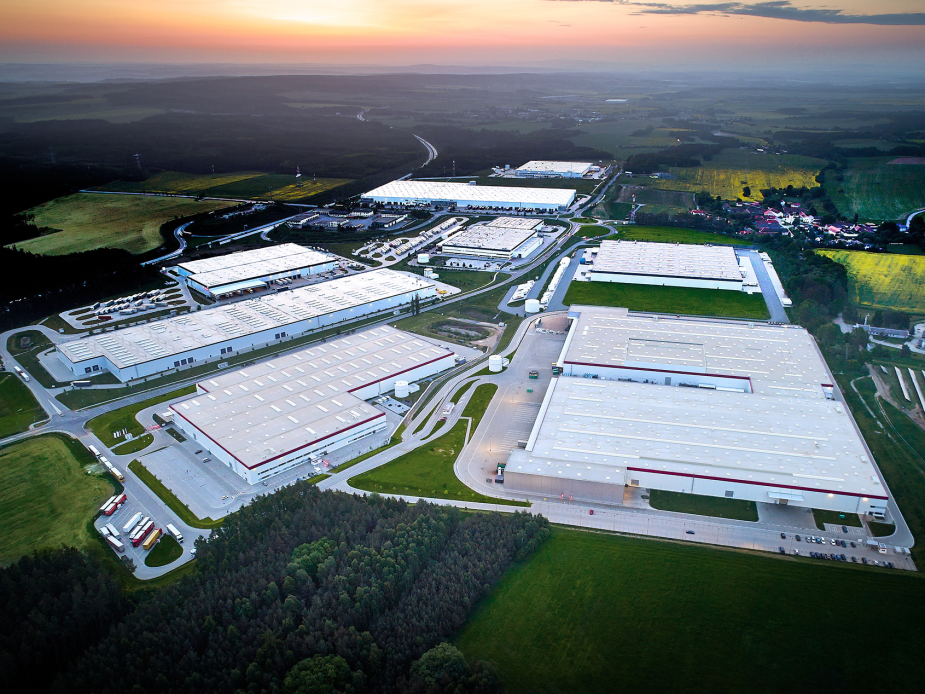
Nearshoring was the answer to yesterday's problem - excessive dependence on distant markets. But the next wave of disruptions will not primarily stem from distance. They will concern access to energy, the cost and availability of labour, the pace of automation, and regulatory and customs shifts. A company that has shortened its supply chain but chosen a facility with no spare power capacity, no expansion of land and no flexible layout has solved one problem while exposing itself to the next set of constraints.
That is why location selection criteria have undergone a fundamental shift. For decades, companies optimised a single variable: the lowest acceptable cost in the right place. Today, the winners are not those who moved production closest or cheapest, but those who chose a location capable of absorbing change they cannot yet foresee. In practice, this means the most important question when selecting real estate is no longer „how much does this cost today”, but: will this location carry the changes I cannot yet predict?
Distance was the problem of the last decade
It is worth honestly separating what nearshoring has already resolved from what remains open.
The pandemic, geopolitical tensions and disruptions to maritime transport exposed the cost of overstretched, single-source supply chains. The response was to shorten and diversify them - bringing production closer to end markets and reducing dependence on single suppliers. This is a genuine structural shift, not a passing trend.
But shortening the supply chain resolved one specific type of risk - excessive dependence on distant markets and global logistics corridors. Most companies have largely dealt with this. The next disruptions will be different in nature, and their shape is not yet known. They have already become part of everyday reality - not the exception, as confirmed by McKinsey research, in which 90% of supply chain leaders experienced disruption in the past twelve months. That is why companies no longer plan for the risk they know, but for the ability to respond to what they do not - and that ability is determined largely by the choice of location and building.
The new currency of location: the ability to absorb change
If location has become a strategic element, its value is no longer measured solely by rent or distance to the customer. It is measured by how much change the facility can accommodate before becoming a constraint. In practice, this ability comes down to four categories of flexibility - and it is these, not the address itself, that are worth paying for today.
Market access remains an advantage tomorrow. Proximity to customers and end markets, key transport corridors and intermodal infrastructure is the baseline. But in a regionalising economy, what matters is not only shorter delivery times but the ability to reorganise distribution when the demand map shifts.
Power with headroom, not on the edge. Automation, fleet electrification, cold storage and modern production processes have made available grid connection capacity one of the first parameters tenants analyse. What matters, however, is not whether power is sufficient today, but whether it can be scaled up tomorrow - because that is what sets the ceiling on the facility's development.
Labour within genuine reach. Even the best-designed building will not run without people. What matters therefore is not only location, but the real commuting catchment area, transport connectivity and the quality of the working environment offered by the building and its surroundings - because these are what reduce turnover and recruitment costs.
Room to change. Land reserves for expansion, structural readiness for automation and a flexible layout determine whether a company will grow in the same location or pay for a costly relocation. Change, however, is not only about scale - it also means tightening energy standards, ESG requirements and mounting climate pressure. A building designed with headroom for these requirements does not force costly retrofits when regulations or the climate raise the bar.
Resilience has a price - and that is where discipline comes in
This is where transparency, often missing from conversations about resilience, is needed. Flexibility is not free. Spare power capacity, land reserves, higher technical standards and a scalable layout are a cost paid today for benefits that may only materialise years later.
The real advantage is therefore not in maximising every possible flexibility, but in choosing precisely those few that matter for a specific operation. For a company betting on automation, power and structural design will be critical. For an operator dependent on labour - workforce reach. For a business in a growth phase - land reserves. Location selection thus becomes an exercise in risk management: not „what might happen”, but „what do I realistically want to be prepared for, and how much am I ready to pay for it”.
What the data confirms
Research by the largest organisations analysing the market shows this shift is structural, not merely narrative.
According to Capgemini Research Institute, the share of large companies investing in nearshoring or reshoring rose from 42% in 2024 to 56% in 2025. At the same time, 73% of organisations are developing a friendshoring strategy - locating production and supply in countries regarded as stable economic partners - and the total value of planned reindustrialisation investments in Europe and the United States is set to exceed USD 4.7 trillion over the next three years.
Similar conclusions come from McKinsey & Company research: around 60% of companies are actively regionalising their supply chains, and 73% are developing a dual sourcing strategy, reducing dependence on single suppliers. Meanwhile, research by Inverto, part of Boston Consulting Group, shows that more than 90% of companies view nearshoring and reshoring as key tools for strengthening supply chain resilience, and 67% of industrial companies plan further regionalisation of their operations.
The conclusions are consistent regardless of source. Companies are not abandoning global reach - they are restructuring it, building models less exposed to shutdowns, delays and sudden cost swings. Regionalisation does not replace globalisation; it makes it resilient.
Where this leads: a resilience premium and a legacy discount
If the ability to absorb change becomes the new currency of location, the industrial real estate market will split in two over the coming years. Facilities and locations that can accommodate change - with spare power capacity, land, flexibility and high technical standards - will hold their value and remain attractive to tenants seeking stability. Those that cannot easily be adapted will start to lose out: first tenants moving to better facilities, and then value - a phenomenon the industry increasingly refers to as a brown discount.
Why Central and Eastern Europe is gaining ground
In this light, Central and Eastern Europe's advantage is changing in nature. The region long competed primarily on cost. Today, its strength is something more durable: a combination of proximity to Europe's largest consumer markets, steadily improving transport infrastructure and access to a skilled workforce - precisely the flexibilities that today's decisions turn on.
The region's position between production, consumer and transit markets also matters. Poland, the Czech Republic, Slovakia and Hungary are naturally embedded in Europe's transport corridors, allowing production, warehousing and distribution functions to be combined in a single operational network. For companies looking to shorten their supply chains while retaining access to the wider European market, this is an advantage cost alone cannot capture. CEE no longer wins on the lowest price - it wins on its capacity to grow.
How this looks at Accolade
The regionalisation of European industry is not a new trend for us but a direction we have factored into portfolio growth since day one. Since 2011, we have been developing industrial and logistics parks in Poland, the Czech Republic, Germany, Slovakia, the Netherlands, Spain and Croatia, selecting locations not only for their position relative to transport corridors but also for available technical infrastructure, labour market potential and scope for further development.
This logic is best reflected in our investments on brownfield sites. Redeveloping a brownfield is not only an environmental benefit and a way to limit new land take. It is built-in flexibility: existing infrastructure and utility connections, and a site already plugged into a transport corridor, reduce risk and shorten the time needed to prepare the facility for new uses. In other words, a brownfield often starts with part of the „capacity for change” already in place.
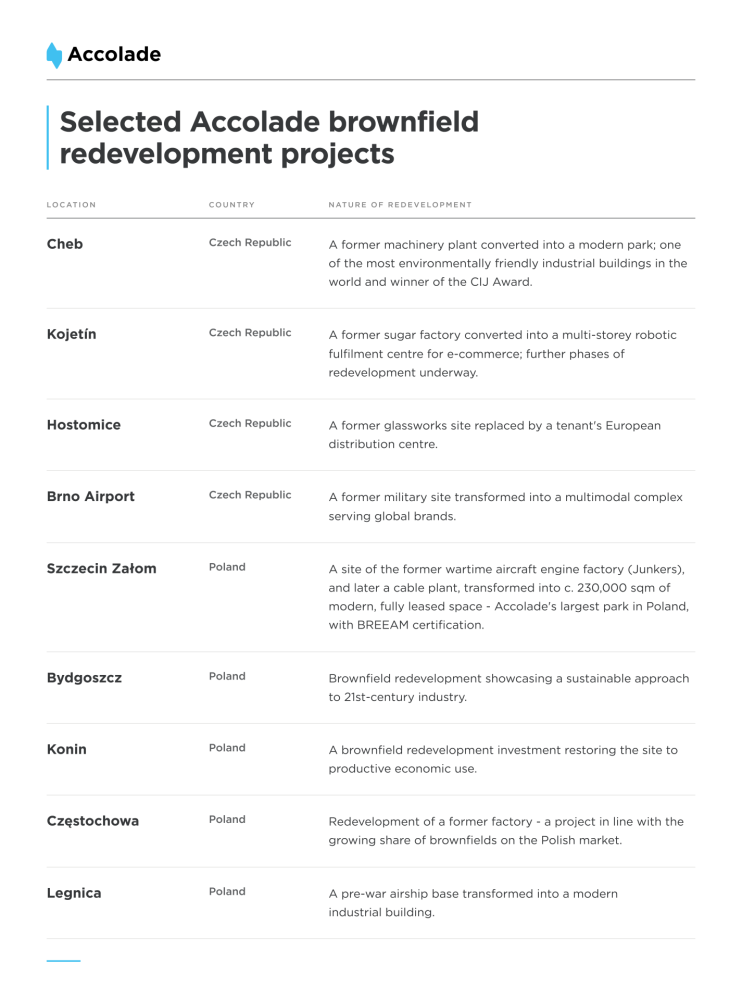
Equally important, we design new investments with long-term development in mind. Buildings are constructed to Accolade White Book standards, achieve BREEAM certification and are prepared for automation, higher energy efficiency and future expansion. This means the location remains an asset even when the tenant's operational processes or business scale change.
„Business resilience begins long before production or a warehouse goes live. It starts at the location selection and building design stage. That is why we look at every investment across the full life cycle - analysing access to infrastructure, scope for expansion, energy efficiency and flexibility of the facility. These are the elements that determine whether a property will still support a tenant's operations in five, ten or fifteen years' time.” - Renata Kozáková, Commercial Director, Accolade
The shift is also visible in how conversations with tenants have evolved. A few years ago, they focused mainly on space availability and delivery schedules. Today they increasingly centre on scope for further development, access to power, the building's readiness for automation and delivery of ESG targets. Location is becoming part of a company's strategy, not merely the address at which it does business.
Location as business infrastructure
Nearshoring answered the question raised by the recent crises: how not to be too far away and too dependent. But that question already belongs to the past. The question for the next decade is different: how to choose a location that can handle change we do not yet know.
For companies expanding production or logistics in Europe, this means that choosing a site is no longer a search for suitable space but a decision about resilience, ability to scale and long-term competitiveness. Location is no longer a point on a map. It is becoming business infrastructure - and, like any infrastructure, it is worth as much as the change it can carry.
Sources
Capgemini Research Institute, The resurgence of manufacturing: Reindustrialization strategies in Europe and the US (2025) - https://www.capgemini.com/insights/research-library/reindustrialization-of-europe-and-us-2025/
McKinsey & Company, Supply chains: Still vulnerable - Global Supply Chain Leader Survey 2024 - https://www.mckinsey.com/capabilities/operations/our-insights/supply-chain-risk-survey-2024
McKinsey & Company, Tech and regionalization bolster supply chains, but complacency looms - https://www.mckinsey.com/capabilities/operations/our-insights/tech-and-regionalization-bolster-supply-chains-but-complacency-looms
Inverto (Boston Consulting Group), 90% of companies see nearshoring as keyway of safeguarding supply chains - https://inverto.com/en/insights/90-of-companies-see-nearshoring-as-key-way-of-safeguarding-supply-chains/
Prologis Research, Supply Chain 3.0: New Strides in Risk Readiness - https://www.prologis.com/insights-news/research/supply-chain-30-new-strides-risk-readiness
Eurostat, Global value chain disruptions and enterprise responses in the EU - https://ec.europa.eu/eurostat/statistics-explained/index.php?title=Global_value_chain_disruptions_and_enterprise_responses_in_the_EU