Certification is only the beginning. What does a well-designed building really deliver for a tenant?
Environmental building certification has become an important part of the industrial real estate market. However, the certificate itself is only the visible outcome. What matters more is the approach behind it - the technologies and materials used, the quality of design and construction, and the broader environmental considerations incorporated throughout the development process.
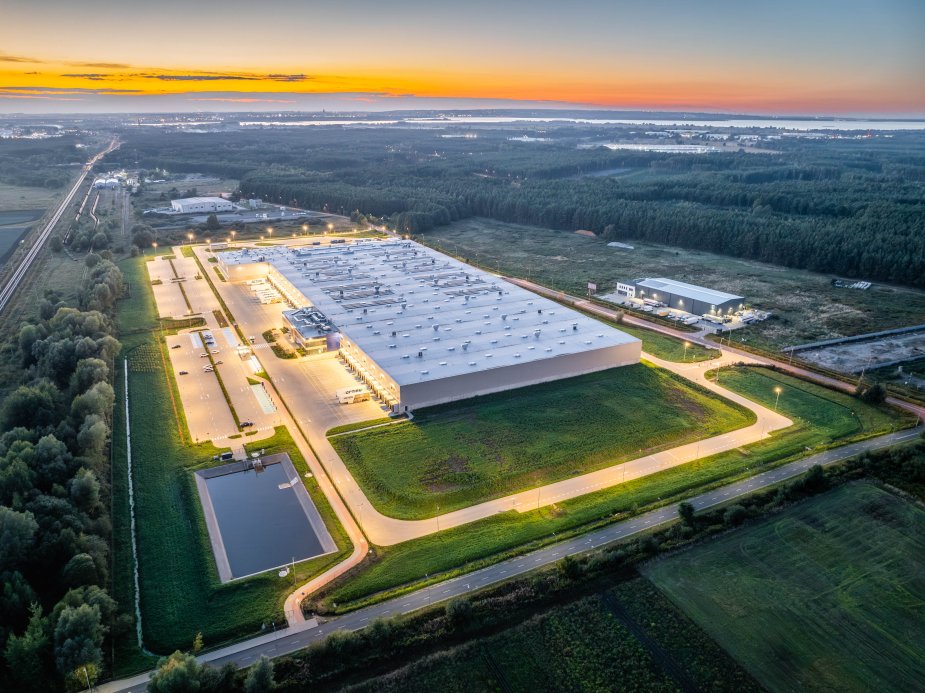
Those solutions are what determine a building's practical value. They help control utility consumption, make costs more predictable, support sustainability reporting, and improve working conditions. That's why at Accolade we treat certification as a starting point, not an end. A certificate sets the direction; the real value of a building comes from solutions that prove themselves in practice.
What does a certificate confirm?
BREEAM is one of the most widely recognised systems for assessing buildings on environmental impact, energy efficiency, and quality of use. We apply it to most of our new investments, and since 2020 every new project certified under BREEAM targets at least Excellent. In selected markets we also use local certification systems, such as DGNB in Germany, which assesses a building across its entire life cycle.
Certification covers areas such as energy and water use, materials, user comfort, transport access, a building's impact on its surroundings, and how the facility is managed.
For a tenant, that's useful to know: it confirms that the building has been evaluated according to a recognised standard.. But the certification level alone doesn't tell the whole story. Two buildings with a similar rating can differ significantly in the specific solutions they use – differences that later affect costs, comfort, and how smooth daily operations run.
What can a tenant really take from it?
The greatest value of a well-designed building shows where technical standards translate into everyday business.
Better data for ESG reporting
An increasing number of companies report environmental data and answer questions from clients, business partners, or investors about the infrastructure they use. Building certification can feed into ESG reports, client questionnaires, tender documentation, and corporate communication.
Operational data matters even more - energy, water, and other utility consumption. In new developments we install smart sub-metering and carry out whole life-cycle assessments of the buildings and currently we are rolling out smart metering across the existing portfolio.
Greater control over operating costs
A well-metered building gives tenants clearer insight into utility use. That makes it easier to spot anomalies, analyse costs, and identify areas to optimise their consumption and operations.
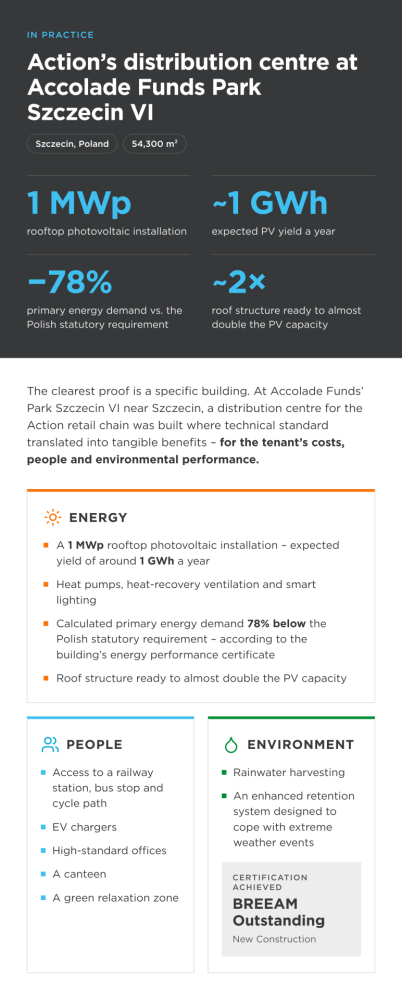
Specific technical solutions matter too. A high-reflectance roof membrane reflects most solar radiation and significantly reduces roof heat gain compared with dark membranes, which helps in cooled areas and improves summer comfort. In practice, that means more predictable running costs and a better basis for conversations about improvements.
Airtightness is another route to lower costs. Air leaks mean uncontrolled heat loss, so we verify build quality with airtightness tests (BlowerDoor). These measure how much air escapes and catch weak points before handover - the tighter the envelope, the lower the heating and cooling bills.
Comfort and better conditions for teams
The standard of the building directly influences the everyday experience of employees. It's not only the hall or warehouse space that counts, but the surroundings, transport access, cycling infrastructure, EV chargers, and relaxation areas.
For companies competing for talent in the logistics sector, workplace quality is becoming an increasingly important part of doing business.
Stronger credibility with clients and partners
In many sectors, environmental factors are now part of how suppliers and business partners are assessed. A certified facility gives a tenant verified, independently assessed information about the building it operates in. That information can be useful in tenders, client conversations, communication with group headquarters, or dealings with financial institutions.
What's worth checking?
When choosing or assessing a building, it's worth asking not only about the certificate, but about the solutions behind it. For tenants, the key questions are:
does the building have a utility-metering system,
what data can be shared with the tenant,
what solutions support energy efficiency,
was build quality independently verified,
what solutions improve employee comfort,
is there room to optimise the building further during the lease.
This matters because certification doesn't end the work on a building. For existing facilities, what counts is whether the owner regularly reviews options to improve them and adapt to changing tenant needs.
How we approach this at Accolade
At Accolade, we look at certification from the perspective of a long-term owner. As of August 2026, we manage 68 parks and 141 industrial buildings totalling 3.9 million m², used by 218 tenants. We set the standard we expect from every building - we define the technical requirements and the target outcome, then consistently verify that they're delivered.
The White Book, our internal technical standard, helps us do this. It's where we record the solutions, we consider worthwhile and require regardless of the minimum certification thresholds - covering energy efficiency, build quality, monitoring of building parameters, resource management, and user comfort.
Brownfield regeneration is also part of our approach: brownfield sites make up approx. 30% of Accolade's portfolio, around 1.1 million m². In practice, this means a certificate is a reference point for us, not the end of the process. What matters most is whether the solutions in place deliver real value to the tenant - in cost, data, working comfort, and long-term building quality.
The certificate as a tool, not a goal
The industrial real estate market is maturing. Many solutions that set certified buildings apart a few years ago are now standard in modern facilities. So, what increasingly matters is not just whether a building is certified, but which specific solutions have been implemented and how they perform in daily use.
For a tenant, a well-designed building supports cost control, client communication, more comfortable working environment and ESG reporting as well.
A certificate sets the direction. But the real value of a building comes from the solutions that shape how the business runs, every single day.
Want to talk about improvements to your building?
If you'd like to discuss ways to optimise or improve your park or building, contact Accolade team: renata.kozakova@accolade.eu